



Modern venue design has shifted dramatically from single-purpose facilities to flexible, multi-functional spaces. This evolution reflects changing community needs, tighter public budgets, and the economic reality that versatile facilities generate more revenue than single-use buildings. Successful multi-purpose venue seating solutions balance capacity, flexibility, and cost-effectiveness — a challenging optimization that rewards careful planning and quality equipment selection.
The Economics of Flexibility
Single-purpose gymnasiums sit empty most daylight hours, used primarily for scheduled physical education classes and evening events. Multi-purpose venues with adaptable seating host conferences, trade shows, graduations, concerts, and community events alongside athletic competitions. This programming diversity can triple or quadruple facility utilization rates. The revenue implications are substantial — many schools and municipalities recover their seating investment within 3-5 years through expanded programming and facility rentals.
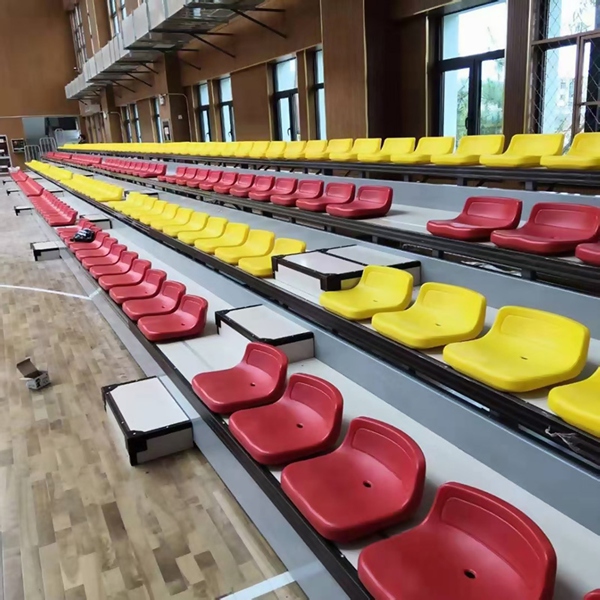
Modular seating systems make this flexibility possible. Unlike fixed bleachers that permanently occupy floor space, modular systems reconfigure in hours rather than days. Telescopic bleachers, movable grandstand sections, and portable seating platforms allow venue managers to match seating capacity precisely to event needs. This right-sizing eliminates both the wasted space of oversized fixed seating and the insufficient capacity of undersized installations. The ability to optimize seating for each event maximizes both revenue per square foot and spectator experience.
Modular Design Strategies
Successful modular seating design starts with understanding the event mix. Venues hosting primarily athletic events with occasional large gatherings benefit from telescopic bleachers supplemented by portable seating for overflow. Facilities hosting diverse events equally might employ multiple modular seating types — retractable bleachers for courtside seating, portable grandstands for end-line seating, and folding chairs for floor seating during assemblies or concerts.
Storage and deployment logistics deserve equal attention. Every seating component needs designated storage locations that don't interfere with other venue functions. Telescopic bleachers solve this by storing against walls, but portable seating requires rack systems or dedicated storage rooms. Deployment time directly impacts event turnover — venues hosting back-to-back events need seating systems deployable within 1-2 hours. Manufacturers offer varying automation levels to meet different speed requirements and budgets.
Integrating Technology and Accessibility
Modern multi-purpose venues must accommodate diverse technological needs. Seating areas need power and data access for media coverage, scoreboard integration, and increasingly, spectator device charging. Quality modular seating systems incorporate raceway systems for power and data distribution without creating trip hazards. Some premium systems even include integrated U等 charging ports in armrests, enhancing spectator experience and differentiating the venue from competitors.
Accessibility compliance is non-negotiable. ADA requirements mandate accessible seating distributed throughout the venue, not concentrated in suboptimal locations. Modular seating systems must accommodate wheelchair spaces, companion seating, and accessible routes to all seating areas. The best designs integrate accessibility so seamlessly that accessible seats offer equivalent sightlines and amenities to standard seats. This isn't just legal compliance — it's good business that expands your potential audience.
Maximizing Return on Investment
Calculating ROI for multi-purpose venue seating requires looking beyond initial costs. Factor in increased programming revenue, reduced maintenance compared to fixed seating, energy savings from reduced HVAC demands in flexible spaces, and extended facility lifespan from reduced wear patterns. Many venues discover that premium modular seating systems pay for themselves faster than budget options because they enable more diverse — and more lucrative — programming.
Partner with an experienced sports facility solutions provider who understands multi-purpose venue dynamics. Quality suppliers offer comprehensive consulting services, from initial space planning through equipment selection, installation, and staff training. They can model different seating scenarios, project utilization rates, and calculate ROI under various programming assumptions. This analytical approach ensures your seating investment delivers maximum value for your facility, your community, and your budget.
References:
International Association of Assembly Managers (IAAM) Facility Planning Guide
Americans with Disabilities Act (ADA) Accessibility Guidelines for Buildings
National Federation of State High School Associations (NFHS) Multi-Purpose Facility Standards
ISO 9001:2015 Quality Management Systems in Seating Manufacturing